
AI SEO: The Complete Guide to Using AI for Search Rankings in 2026
Quick Takeaways
- AI SEO means using artificial intelligence to improve your rankings in both traditional search engines and AI-generated answers — keyword research, content optimization, technical audits, and LLM visibility all fall under this umbrella
- Google’s AI Overviews and LLM-based search engines like Perplexity now answer queries directly, which means optimizing for AI search results is just as important as ranking in the blue links
- Nightwatch is the only rank tracker that bridges traditional Google rank tracking and AI/LLM visibility monitoring in a single platform — critical for measuring the full picture of your search presence
- Using AI for SEO without human review creates thin content that fails E-E-A-T standards — AI should handle the heavy lifting while humans add expertise and judgment
- The SEO professionals gaining the most ground in 2026 are those running AI-assisted workflows for research, auditing, and tracking while keeping strategy and content quality firmly under human control
SEO has never stood still. Every few years, a shift arrives that forces practitioners to rethink how they work: PageRank, Panda, RankBrain, Core Web Vitals. In 2026, that shift is AI SEO.
AI SEO is not just about using ChatGPT to write faster blog posts. It covers a complete rethinking of how you research keywords, audit technical health, analyze competitors, create content, and — critically — how you measure visibility in a search landscape where AI-generated answers are eating into traditional organic traffic.
This guide covers everything you need to know about using AI for SEO in 2026: what it is, how it works, which tools are worth your time, and how to build a workflow that actually improves rankings rather than just generating noise.
- What is AI SEO?
- How AI is Changing SEO in 2026
- 6 Ways to Use AI for SEO Right Now
- AI SEO Tools Worth Using
- How to Use AI for SEO Without Hurting Rankings
- AI Search vs Traditional SEO: What’s Different?
- Building an AI SEO Workflow
- FAQ
What is AI SEO?
AI SEO is the application of artificial intelligence — machine learning, natural language processing, and large language models — to the practice of improving a website’s visibility in search engines.
The key technologies involved:
- Machine learning (ML) identifies patterns in search data that humans cannot spot manually. It powers ranking prediction, trend forecasting, and anomaly detection in traffic data.
- Natural language processing (NLP) allows tools to understand the semantic meaning of text, enabling more accurate keyword clustering, content gap analysis, and relevance scoring.
- Large language models (LLMs) — the same technology behind ChatGPT and Google’s AI Overviews — can generate, evaluate, and improve content at scale.
Put simply, AI SEO lets you do in minutes what used to take hours, and surface insights that would be invisible without computational analysis of large datasets.
But AI SEO in 2026 has a second meaning: it also refers to optimizing your site so it appears in AI-generated answers. Google’s AI Overviews, ChatGPT web search, and Perplexity all generate answers that pull from websites. Getting cited in those answers is a new category of search visibility that traditional rank tracking tools do not measure.
That is why tracking your AI search visibility alongside Google rankings has become essential.
How AI is Changing SEO in 2026
Three major developments have reshaped SEO and explain why using AI for SEO is no longer optional for competitive niches.
Google AI Overviews Are Reducing CTR on Traditional Results
Google’s AI Overviews appear above organic results for a large and growing share of informational queries. When a user gets a complete answer in the AI Overview, they are less likely to click through to individual pages. Studies tracking early AI Overview rollouts found click-through rate drops of 20–60% on affected queries.
The sites that appear as sources inside AI Overviews, however, continue to get traffic. Optimizing for AI Overview citations has become a priority for content-heavy sites in 2026.
LLMs Are a Search Engine Category of Their Own
ChatGPT’s search mode, Perplexity, and similar tools now have hundreds of millions of users conducting real research queries. These are not the same as Google searches — users are asking longer, more conversational questions and reading synthesized answers rather than lists of links.
Getting mentioned and cited in LLM-generated answers requires a content strategy focused on authority, clear factual statements, and structured information that is easy for models to extract and attribute.
Nightwatch’s LLM tracking feature is built specifically to monitor this — showing you where your brand and content appear in AI-generated responses so you can measure and improve that visibility over time.
Algorithm Updates Are Getting Faster and Less Predictable
Google’s core update cadence has accelerated, and the signals being weighted have shifted toward genuine expertise and brand authority signals that AI can help you monitor but not fabricate. Staying on top of ranking movements requires a rank tracker that surfaces changes quickly — not just weekly snapshots.
6 Ways to Use AI for SEO Right Now
As of 2026, 86% of SEO professionals have integrated AI into their workflows, reporting a 45% increase in organic traffic and a 25% increase in conversions. Here is how the best practitioners are actually using AI for SEO.
1. Keyword Research and Clustering
Keyword research is the foundation of SEO, and AI makes it dramatically faster and more accurate. Rather than manually pulling lists from a single tool, AI can synthesize data across multiple sources, predict emerging trends, and automatically group keywords by intent.
With the Nightwatch SEO AI Agent, you can prompt directly against your live search data:
"Give me a list of high-traffic, low-competition keywords related to [your topic or niche]. Include search volume and difficulty if available."
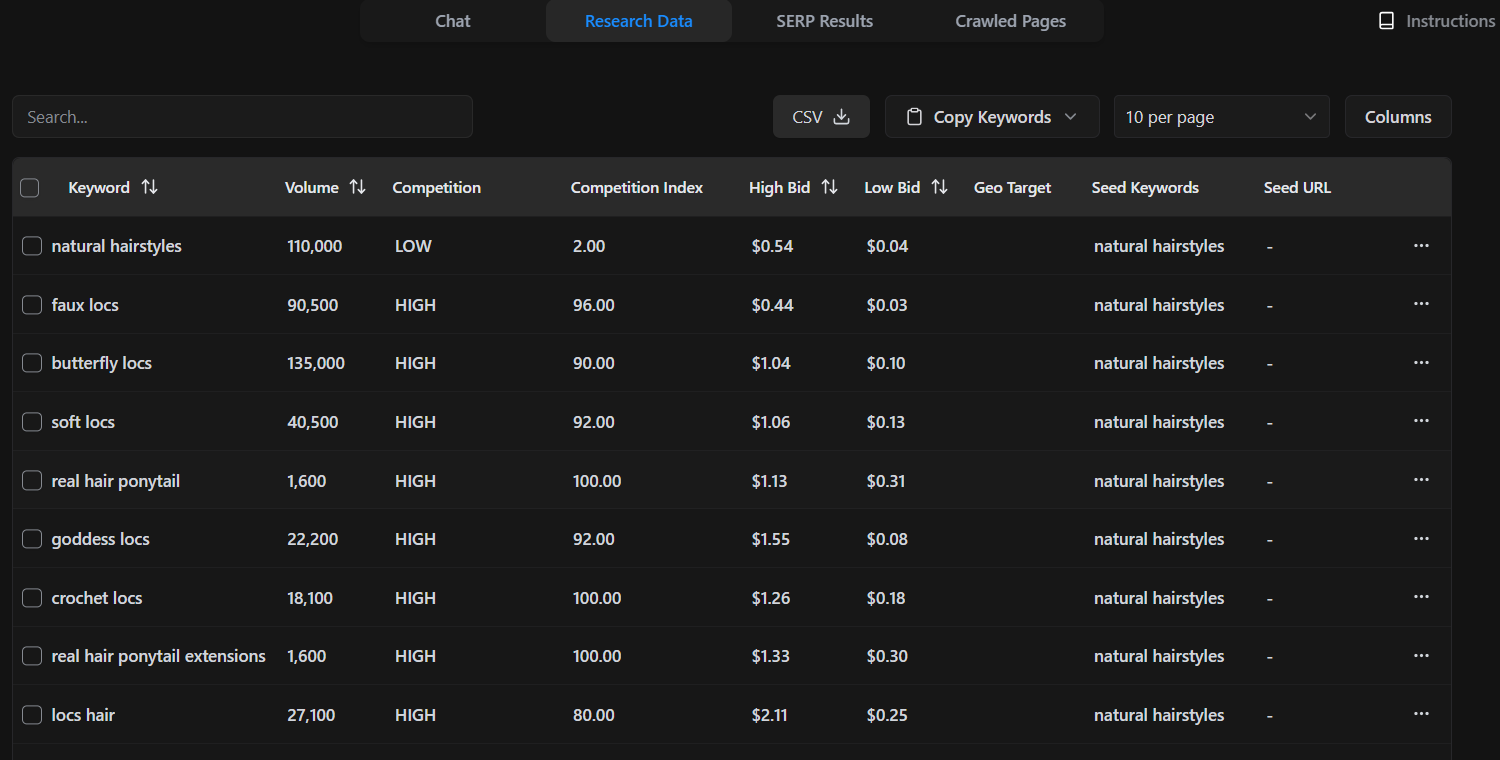
Need those keywords organized into content clusters? Add a follow-up prompt:
"Group these keywords into relevant keyword clusters based on search intent and semantic similarity."
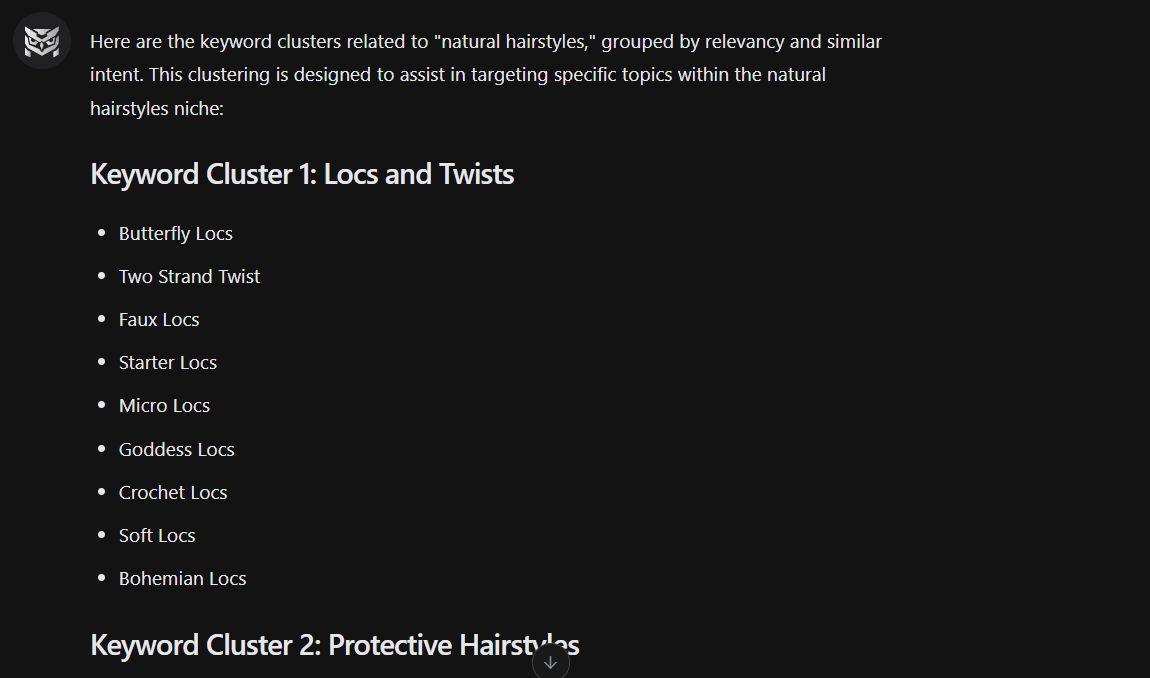
Because the Nightwatch AI Agent works against your real ranking data, the clustering reflects your actual competitive landscape — not just a generic model prediction. You can also ask it to crawl competitor domains and surface the long-tail keywords they rank for that you do not.
2. Content Optimization
AI content optimization tools have matured significantly. The best use cases in 2026 are not about generating full articles from scratch — it is about using AI to close the gap between what you have published and what the top-ranking pages are doing better.
Practical ways to use AI for content optimization:
- Identify missing semantic terms and entities that top-ranking pages cover
- Audit headings and internal link structure against competitor content
- Rewrite underperforming sections with a specific prompt directing tone and target keywords
- Check whether your existing content addresses the full scope of search intent for a query
The Nightwatch SEO AI Agent can analyze your existing pages and highlight missing keywords, over-optimized sections, or structural weaknesses — grounding those recommendations in your actual ranking positions rather than just theoretical best practices.
For research and drafting, Perplexity is useful for assembling referenced factual context before writing. ChatGPT excels at rewriting and expanding specific sections when given a clear prompt.
3. Technical SEO Audits
Technical issues — broken links, slow page loads, missing canonical tags, crawl errors — can silently undermine rankings even when your content strategy is solid.
AI speeds up technical auditing by processing crawl data at scale and surfacing prioritized recommendations rather than raw lists of issues. Instead of reviewing 500 flagged issues and trying to figure out which matter, you get actionable summaries.
With the Nightwatch AI Agent, you can prompt a full-site technical audit:
"Perform an SEO audit for the website [insert URL]. Identify technical issues, on-page SEO problems, broken links, slow-loading pages, and missing meta tags. Provide suggestions for improving site speed, mobile responsiveness, keyword usage, and overall SEO performance."
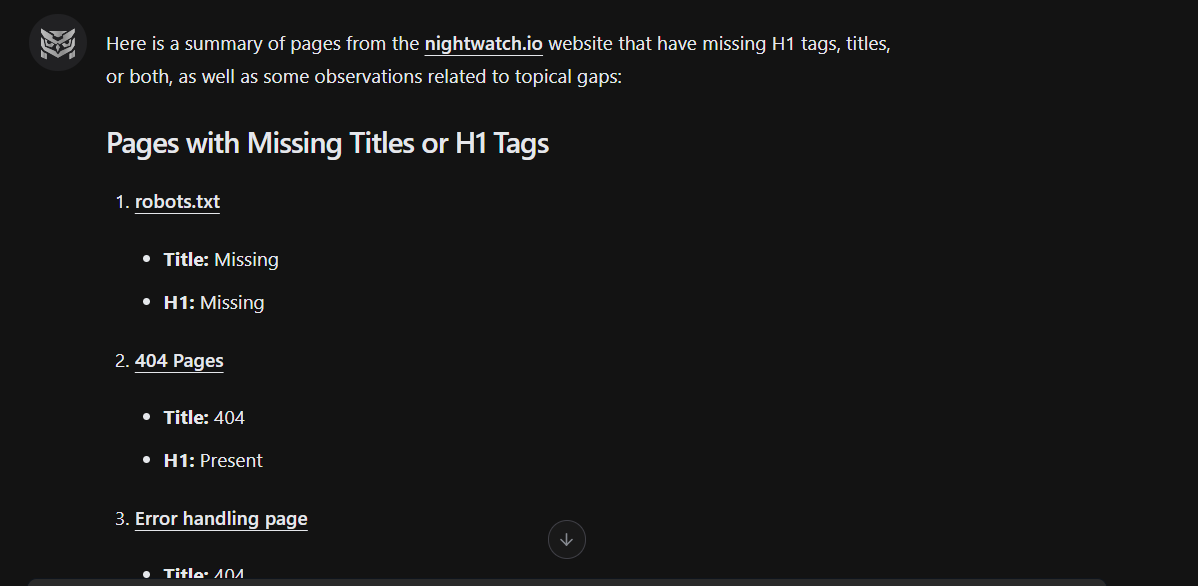
ChatGPT is also useful for translating technical audit output into plain language: "Explain how to fix a canonical tag issue for a beginner." This is especially valuable when working with development teams who need clear briefs rather than raw SEO jargon.
4. Competitor Analysis
Understanding what your competitors are doing well — and where they are vulnerable — is one of the highest-leverage activities in SEO. AI compresses the time required from days to minutes.
The Nightwatch SEO AI Agent can pull a competitor’s ranking pages and identify which keywords and content formats are driving their traffic, then surface gaps where your site could compete. You can also use it for content gap analysis — finding the specific topics and keywords your competitors rank for that you have not addressed.
“Identify content gaps between my website [insert your domain] and my top competitors [insert their domains]. Show the keywords or topics they rank for that I don’t, along with search volume and ranking URLs if possible.”
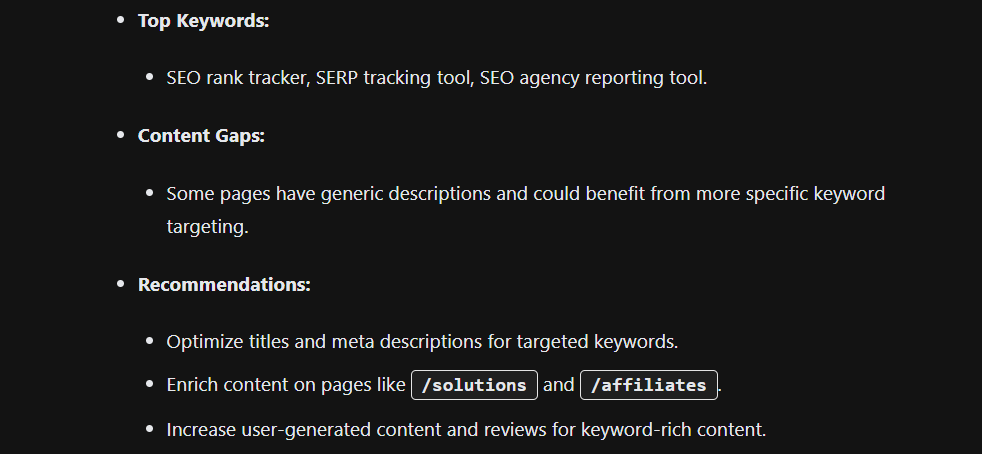
For backlink opportunities, you can ask the AI agent to surface recently acquired links in your niche and generate outreach templates tailored to those domains.
5. Rank Tracking and Performance Monitoring
Rank tracking is where AI adds a layer that was previously missing: not just showing you where you rank, but explaining why rankings changed and what to do about it.
Regular tracking catches sudden drops before they compound, measures the ROI of SEO work, and surfaces early positive signals you can double down on.
Nightwatch monitors keyword rankings across Google, Bing, and other search engines at daily granularity, with SERP volatility alerts and historical trend views. The AI Agent can explain ranking drops in context — correlating them with algorithm updates, content changes, or competitor movements — and recommend next steps.
Critically, Nightwatch also provides AI tracking to monitor how your brand and content appear in AI-generated search results: Google AI Overviews, ChatGPT, and Perplexity. This gives you a complete picture of your total search presence, not just blue-link positions.
6. LLM Visibility Optimization
This is the newest frontier of AI SEO: optimizing your content to appear as a cited source in AI-generated answers.
LLMs favor content that is:
- Factually authoritative — specific claims with cited sources, original data, expert perspectives
- Clearly structured — short paragraphs, descriptive headings, and definitions that are easy to extract
- Brand-consistent — entities (your brand, your product names, your key people) mentioned consistently across your domain so models can identify who you are
- Well-cited by others — backlinks from authoritative domains remain a signal that LLMs weight
Monitoring your LLM citation rate requires dedicated tooling. Nightwatch’s LLM tracking feature tracks where and how often your brand appears in AI-generated answers, enabling you to measure progress as you optimize content for this new visibility layer.
AI SEO Tools Worth Using
There is no shortage of AI SEO tools, but not all of them are equal. Here is an honest breakdown of the ones worth integrating.
Nightwatch — Rank Tracking + AI Visibility in One Platform
Nightwatch is the rank tracker built for SEO in the AI search era. It handles everything you expect from an enterprise-grade tracker — daily keyword ranking updates, SERP feature tracking, competitor monitoring, local rank tracking — and extends it with AI-native capabilities.
What makes it different:
- NightOwl AI Agent — an AI assistant that works directly against your live Nightwatch data to answer questions about your rankings, diagnose issues, and surface opportunities. Unlike general-purpose LLMs, it has access to your actual performance data.
- AI / LLM visibility tracking — monitors how your brand and pages appear in Google AI Overviews and LLM-based search tools like ChatGPT and Perplexity
- SERP volatility alerts — notifies you when rankings shift so you can investigate immediately rather than discovering drops in a weekly report
Nightwatch is particularly effective as the measurement layer of an AI SEO workflow. You use other tools to create and optimize content, but you use Nightwatch to verify that your efforts are actually moving rankings — in both traditional and AI search.
ChatGPT — Research, Drafting, and Strategy
ChatGPT is most useful for:
- Drafting content outlines and expanding sections with specific prompts
- Generating meta tag variations for A/B testing
- Explaining technical SEO concepts in plain language for stakeholder briefs
- Brainstorming content angles to outperform competitor articles
The limitation is that ChatGPT does not have access to your actual ranking data. It produces outputs based on its training, which means recommendations need to be validated against real performance data.
Surfer SEO — On-Page Optimization Scoring
Surfer analyzes the top-ranking pages for a target keyword and produces a content score based on terms, headings, word count, and structure. It is useful for calibrating content optimization against what is currently working in the SERPs, though it tends to optimize toward surface-level correlations rather than genuine quality signals.
Semrush AI Features
Semrush has integrated AI across its keyword research, content brief generation, and competitor analysis tools. It is a comprehensive suite that works well if you are already in the Semrush ecosystem, though it can be expensive for teams focused primarily on rank tracking.
How to Use AI for SEO Without Hurting Rankings
AI SEO done wrong can actively damage your site. Here is what to avoid and how to stay on the right side of Google’s quality guidelines.
The Thin Content Risk
The most common mistake: using AI to generate large volumes of content quickly without editorial review. AI-generated text that lacks original insight, specific data, or expert perspective is exactly what Google’s helpful content system is designed to demote.
The fix: use AI for structure, research synthesis, and drafting — then invest human time in adding original examples, proprietary data, expert opinions, and the perspective that makes your content genuinely useful rather than a repackaging of existing information.
Over-Automation and Loss of Brand Voice
When every piece of content passes through the same LLM prompts with minimal variation, your site begins to sound generic. Brand voice, distinctive formatting patterns, and a recognizable perspective are signals of a real editorial operation — and readers notice their absence.
Use AI as a co-writer, not a ghostwriter with no editorial direction. The best results come from specific, constrained prompts that fit a defined content strategy rather than “write me a blog post about X.”
E-E-A-T Issues
Google’s E-E-A-T framework (Experience, Expertise, Authoritativeness, Trustworthiness) increasingly shapes how pages are evaluated for ranking. AI cannot provide real experience or demonstrate genuine expertise — these must come from the people behind the content.
Practical steps to maintain E-E-A-T:
- Every post should have a named author with a real profile and credentials
- Include first-person examples, case studies, and screenshots where possible
- Cite specific, verifiable sources for every statistic — do not use AI-generated citations that may not be real
- Build author pages that establish topical authority across a body of work
Keyword Stuffing from Poor Prompting
AI tools, when not given explicit constraints, sometimes over-optimize for keyword frequency. The result is text that reads as though the keyword has been inserted mechanically rather than used naturally in context.
Review AI drafts for keyword distribution before publishing. If a target phrase appears in every paragraph, revise for natural use. Google’s NLP systems recognize genuine topical coverage — you do not need to hit an arbitrary keyword density number.
AI Search vs Traditional SEO: What’s Different?
Understanding the difference between optimizing for traditional Google results and optimizing for AI-generated answers is essential for any AI SEO strategy in 2026.
Traditional SEO: The Blue Links
Traditional SEO optimizes for Google’s algorithm-ranked list of links. The ranking signals are well-understood: content relevance, backlink authority, technical health, user experience signals. You rank by being the best answer to a query as judged by Google’s systems.
Success is measured by keyword position, click-through rate, and organic traffic.
AI Search and GEO (Generative Engine Optimization)
AI-generated answers from Google AI Overviews, ChatGPT, and Perplexity select sources differently. They are not returning the best-ranked page — they are synthesizing an answer from multiple sources and citing those they draw from.
GEO (Generative Engine Optimization) is the emerging practice of optimizing for this new format. Key differences from traditional SEO:
- Entity recognition matters more — LLMs need to clearly identify your brand and understand what it does. Consistent brand mentions, structured data, and clear “About” information help.
- Structured, extractable content is favored — clearly written factual claims, definitions, and lists are easier for LLMs to incorporate than dense narrative paragraphs
- Authority is still relevant — pages with strong backlink profiles from credible domains appear more frequently as AI citations
- SERP position is less directly correlated — a page ranked #7 for a query might appear in an AI Overview while the #1 page does not, depending on how well its content maps to the AI’s answer construction
Nightwatch’s AI tracking gives you visibility into both dimensions: where you rank in traditional results and whether you are appearing as a cited source in AI-generated answers.
Building an AI SEO Workflow
Here is a practical step-by-step workflow for using AI for SEO in 2026 that combines speed with the editorial quality required to rank and be cited.
Step 1: Identify Opportunities with Data
Start in Nightwatch. Review your ranking positions to identify:
- Keywords ranked in positions 11–20 (page two, where small improvements yield large traffic gains)
- Pages that have dropped in rankings in the past 30 days
- Competitor pages that have gained rankings on keywords you target
This data-first approach ensures your AI work is directed at the highest-value opportunities rather than random content production.
Step 2: Research with AI Assistance
Use ChatGPT or Perplexity to rapidly synthesize background research on your target topic — competitive content, statistics, expert perspectives. Use the Nightwatch AI Agent to surface related keywords, content gaps, and SERP feature opportunities.
Treat AI research output as a starting point, not a final product. Verify every statistic against its primary source.
Step 3: Create Content Briefs
Use AI to generate a detailed content brief: recommended headings, target keywords and their intent, questions to answer, suggested word count, and internal link opportunities. This is one of the highest-leverage uses of AI — a well-structured brief dramatically improves the quality of content produced downstream.
Step 4: Draft and Enrich
Use AI to draft sections of the content, but enrich every section with:
- Original examples or case studies from your own work
- Screenshots, data visualizations, or product demos
- Expert quotes or first-person perspective
- Specific, cited statistics from named sources
This is the step that determines whether content is genuinely helpful or just AI-generated filler.
Step 5: Optimize Before Publishing
Run the draft through your on-page optimization review: target keyword placement in title, first paragraph, and H2s; internal links to related posts and product pages; meta title and description; image alt text.
The Nightwatch SEO AI Agent can review your page’s existing performance data and flag whether similar pages on your site have structural or content weaknesses to address.
Step 6: Publish and Track
Publish the content and add the target keywords to Nightwatch tracking if not already monitored. Set up alerts for ranking changes. Check back at 30, 60, and 90 days to measure ranking progress and identify pages that need a content refresh.
Use Nightwatch’s AI tracking to monitor whether the content is being cited in AI-generated answers for relevant queries.
Step 7: Iterate
SEO in 2026 is iterative rather than set-and-forget. AI tools make it faster to:
- Refresh content that has dropped in rankings
- Expand thin sections identified in a follow-up audit
- Add new sections targeting related keywords the page is starting to rank for
- Monitor competitor content that is gaining on your target keywords
A regular cadence of content reviews — monthly or quarterly depending on your site’s scale — is where compounding SEO gains come from.
Frequently Asked Questions
What is AI SEO?
AI SEO is the use of artificial intelligence — including machine learning and natural language processing — to improve a website’s search engine rankings. It automates and enhances tasks like keyword research, content optimization, technical auditing, competitor analysis, and rank tracking. In 2026, AI SEO also includes optimizing for AI-generated answers in tools like Google AI Overviews, ChatGPT, and Perplexity.
Does using AI for SEO hurt rankings?
Not if done correctly. Using AI to assist with research, generate outlines, and surface optimization opportunities is safe and effective. The risk comes from mass-publishing thin, unedited AI-generated content without adding real expertise or original insight. Google’s helpful content guidelines reward depth and genuine E-E-A-T regardless of how content is produced.
What is the best AI SEO tool?
The best tool depends on the job. For rank tracking and AI/LLM visibility monitoring, Nightwatch is the leading option. For content drafting and research, ChatGPT and Perplexity are widely used. For on-page optimization scoring, Surfer SEO is popular. Most effective AI SEO workflows combine two or three tools rather than relying on a single platform.
How does AI SEO differ from traditional SEO?
Traditional SEO focuses on optimizing for Google’s blue-link results. AI SEO extends this to include optimization for AI-generated answers, uses AI tools to accelerate research and audits, and applies machine learning to surface patterns in large datasets that would be impossible to spot manually. The measurement layer is also different — tracking rankings in traditional SERPs is now only part of the picture.
Can AI replace SEO professionals?
No. AI dramatically speeds up repetitive tasks and surfaces insights from large datasets, but SEO still requires human judgment for strategy, content quality, brand voice, and relationship-based link building. The SEO professionals gaining the most ground in 2026 are those using AI as a force multiplier rather than a replacement.
How do I track AI search visibility alongside Google rankings?
Nightwatch lets you track both in one platform. You can monitor keyword rankings in Google, Bing, and other search engines while also tracking how your brand and content appear in AI-generated answers from ChatGPT, Perplexity, and Google AI Overviews using the Nightwatch AI tracking feature.